
2023 Election: Voters approve update to Founding Law, amendment to 2018 Succession Law
The 2023 Winter Solstice Election has closed, and voters approved all ballot measures by wide margins. On the Sôgmô’s legitimacy, citizens voted unanimously in support of their government, meaning that the Sôgmô will govern Sandus for another year. At the same time, voters approved two national referenda that amend the 2018 Succession Law with two abstentions, and another that ratifies the Sôgmô’s proposed update to the 2011 Founding Law. Both were necessary, the Sôgmô explained in this year’s Blue Lecture, to begin to transform Sandus into a community-based government and to bring our most fundamental into a new decade so that it made sense to citizens.
The updated Founding Law referendum passed with unanimous support, but a two-thirds of voters chose to approve the update outright instead of waiting for a synchronous meeting of the Council around the Spring Equinox.
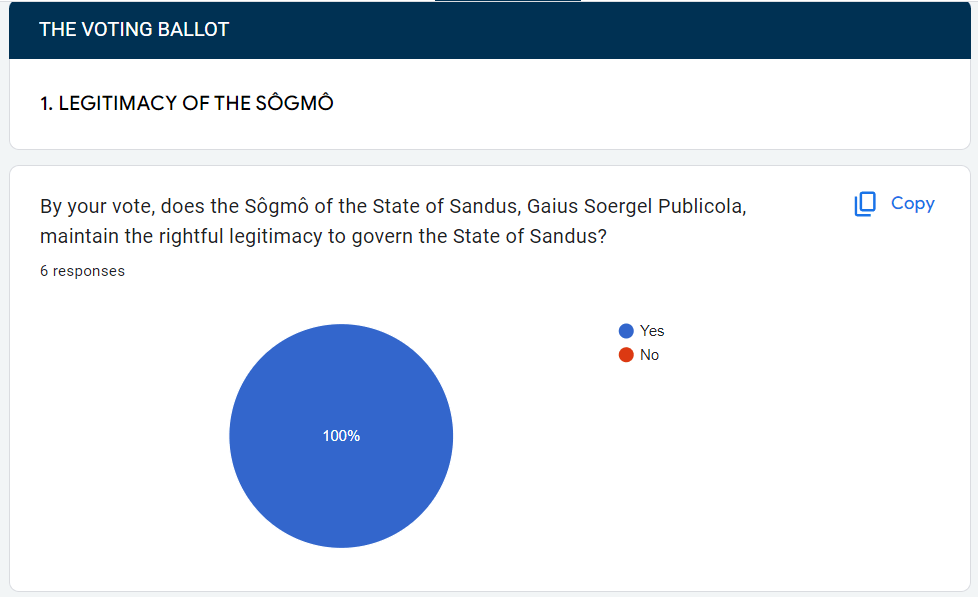
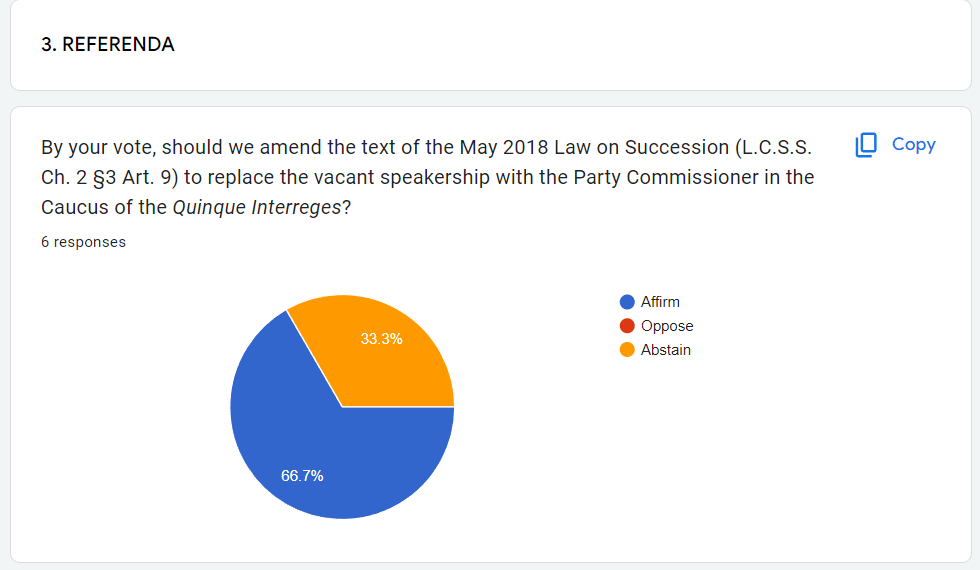
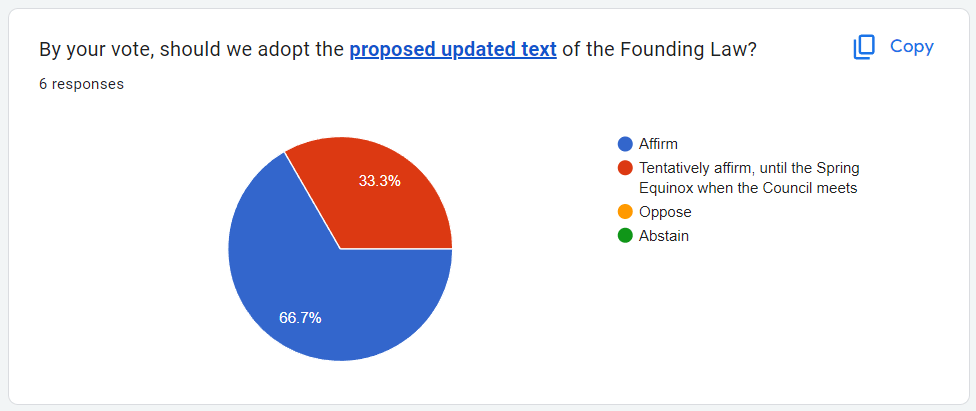
In terms of turnout, however, this year’s election is complex. Out of active and eligible voters, 67% of Sandum citizens voted in the election. But, out of all 17 eligible voters, only 9 (53%) are considered to be active, suggesting a pernicious slump in activity since the 2020 coronavirus pandemic and its worldwide lockdowns and health measures. At the same time, despite those lingering concerns about activity in the months since the dissolution of the Social System—a system that was, in 2013, the Sôgmô’s solution to a similar crisis of citizen activity and participation—half a dozen active citizens still represents a sizeable cushion of active citizens relative to our size. Not to mention that activity in Sandus cuts across in varying ways with no perfect one-size-fits-all model, since some citizens pay less attention to micronational politics and more to our micronation’s activities.
Sandum society arises from the camaraderie of the sovereign people united as workers, householders, and intellectuals. The People of Sandus shall provide for the people’s expression and welfare equally; protect the health, safety, and welfare of the people; provide for the modernisation of coöperatives and labour; provide a program of education that is open and free to all; provide for planned development of the state and its activities according to and in preparation of society’s needs; and, provide for the protection of culture and the securement of the people’s welfare by education and mutual aid.
Article 7 of the updated Founding Law
Now that the votes have been counted, however, the election furnishes the Sôgmô with a clear mandate to continue their «Sandus for Householders» Plan, a reference to the updated Founding Law’s programmatic statement of Sandus as a “union of workers, householders, and intellectuals.” Our political system sees these aims as the ultimate goal of our micronation that, in a phrase, means to better the welfare of our citizens in whatever way we can. In doing so, Sandus postures itself as a whole as a refuge for its citizens who are our participatory members and philosophical adherents (citizens), and related or supportive adjacents.
At the same time, Sandus’s government will increasingly act as a discrete body that represents and does work on behalf of our community, and avenues will be explored to bring that community into socialist and democratic governance with the Central People’s Government. Already, the Sôgmô has proposed having plenary citizenship meetings around the equinoctes and solstices in the Council, and other citizens have suggested having new asynchronous capabilities for citizens unable to attend those assembly meetings. One suggestion has been to create a procedure to allow for citizens, who request one, to have a “seven-day vote” over all votes conducted in the Council’s synchronous meetings. The Party will also be an active participant in government, as its Central Committee assumes a larger executive role over the whole of the government and as Party members begin to take on a more active role in terms of citizen activity and civil service.
Hopefully these political changes laid out in the Blue Lecture, the sagamorial plan, and in the run-up to the election will translate into a micronational government that is more user-friendly for members of our political community. Transforming Sandus into a communal refuge during these difficult and uncertain times will take all of us Sandum householders, and we will shape our government for us all.
Charity Taxes: Report expected next week
Party Congress elects new Central Committee, charts new political course
Originally scheduled for 4 November, this year’s XIII Party Congress met on 19 November to elect a new Party Secretary and to plan its arduous path to writing a new Party platform that will represent Sandus and its politics today. In the end, the congress elected Artemis Langford as its new secretary, and reëlected Commissioner Wren Wood, each with only one abstention. Remarks from each of the members of the Party’s Central Committee emphasised the importance of this political moment and how Sandus can wield its micronational power in unique ways, with each member giving their vision for Sandus at the heart of protecting and advancing the causes of our workers.
Discussions on the Party platform focused on two areas especially, but a third also came up as an area the central committee will have to consider in more depth. The platform’s programmatic agenda toward the State of Sandus as a whole under the section “Sandus and the State” kept most of the day’s proceedings. In the Party’s confidential deliberations, members emphasised that the Party is a coequal branch in our micronation’s Central People’s Government and that we are a worker’s government, but we must be fully committed to being a worker’s state—and, in our context, that means being aware of our micronation’s activity. The Party is, after all, the political organisation of active Sandum workers.
Next, in terms of our socialist economy, deliberations focused on worker’s self-management and our communal liberation from waged labour, as well as recognition and subvention of unpaid labour. The Sôgmô suggested moving away from coöperatives, which have long existed in Sandum life as associations of workers, not as enterprises. For context, the Common Economy of the Social System has now become the Common Economy of our Sandum political community alone, reshaping the participants and their collective interests, but Sandus and the Party must still be conscious of how citizens may collaborate with one another communally, according to the individual workers involved.
Finallly, the Central Committee voted to also take up consideration of Sandus in the World, since our micronation’s place relative to the world is far different from 2017 when the last platform was written.
The Sôgmô presented the initial points of their «Sandus for Householders» Plan released in their Blue Lecture. The congress made no motions, but heard and deliberated on the individual points.
The party now sets out to complete the platform in the next year, creating and shaping the vision of a country charting a course through the perilous straits between chaotic world events.
Sôgmô unveils «Sandus for Householders» Plan in Blue Lecture
Earlier this month, the Sôgmô announced at last their nine-step plan to transform Sandus into a micronation designed for citizens who have other prevailing commitments. Long floated throughout the year, the plan hopes to lessen the burden on individual citizens and to encourage community involvement at many stages of public administration and political decision-making, significantly reshaping how Sandus is structured and thinks of itself. Long committed to replicating the activity of macronational states, the plan fundamentally reshapes a citizen’s relationship to the state that has today become the corporate body represented by our lawful association of citizens.
The plan has nine steps that will begin the process of fundamentally reshaping Sandum government in the new year and beyond. A third of the steps detail significant changes to Sandum law and operating rules, namely updating our Founding Law, the 2018 Succession Law, and our democratic assembly’s rules and procedures. Later this month or in the new year, the Sôgmô will submit a resolution to adopt new Rules and Procedures for the Council to hold legislative meetings around the Equinoctes and Solstices. These changes especially hope to change Sandum governance into one of a community government, and so will now encourage direct participatory democracy in our micronation.
Another three points focus on reshaping our Central People’s Government, especially when it comes to local government and citizen involvement. The Sôgmô will establish by edict three State Committees, a new type of state organ, that feature citizen focus groups making decisions in three policy areas: our common economy, local governance, and Sancta culture. At the same time, the Sôgmô will shake up the current organisation of our provinces and will include new local municipalities, especially in the broader Laurentian, Appalachian, and Atlantic Coast regions of our micronation. Finally, the Sôgmô will empower specific citizens to become responsible for bettering their local Sandum community and reaching out to those interested in our national philosophy and interests.
Finally, the plan’s last third details a citizen’s involvement in the State of Sandus, the corporate body that represents our civic association. Earlier this year the Sôgmô announced service quadrants, envisioned as “tribes” responsible for doing socialist-oriented community service in a particular season. At the same time, service projects have begun to proliferate, and in the future the Sôgmô will increasingly facilitate citizen involvement in discrete parts of our goverment. The same is included in cultural projects, which have heretofore largely been a sagamorial prerogative. Again, the Sôgmô will increasingly facilitate community involvement in shaping Sancta culture, beginning with the announcement of a mythical short story competition with a $100 USD prize.
The plan’s last point is not so much an action as a change of view. We have long strived to ensure Sandus is like any other state, responsible for the activities and wellbeing of our people, but under the plan we recognise that Sandus includes a citizens’ community and a state that represents our abstract, corporate body. This distinction, between nation : community and state : corporate body, is of course an empty dichotomy that Sandus all encompasses and transcends.

Kara Oberstadt, “Mater Matriae,” awarded membership in highest State award
For several years, many citizens have joked that she is our Sandum mater matriae, “mother of the motherland,” a play on the Roman emperor Augustus’s honorific title pater patriae. Today, Kara Nerva Oberstadt receives membership in our highest state decoration, the Most Honourable Order of the Throne of Sandus, in recognition of her longtime dedication to our micronation, our association of citizens, and her selfless performance of charity for the benefit of citizens and many others outside Sandus, especially in her local area and at her church. Kara is a consistent provider of charity in our micronation, and at the height of the pandemic welcomed people from across the continent at their times of need into her home. An avid crafter, Kara is an active participant in Sandus’s association of artisans and craftspeople and has helped many others, including the Sôgmô, in craftmaking, etiquette, and more.
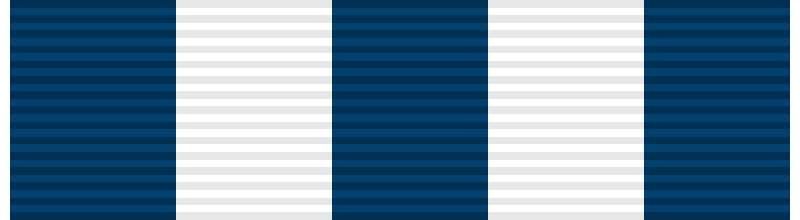
In recognition of her tireless activities for the benefit of our community, the Sôgmô proclaims Kara Nerva Oberstadt MOTS.
 sandus.org
Leave a comment